Who are the National Bee Unit?
Watch our Bees, Beekeepers and the National Bee Unit below to find out more about our vital work.
Quick links to common queries about:
BeeBase
What is BeeBase?
BeeBase is the NBU's website, which contains a wide range of beekeeping information such as the activities of the NBU, the bee related legislation, information about pests and diseases, interactive maps, current research projects, publications, advisory leaflets and key contacts. Beekeepers can sign up online and view their own apiary records, diagnostic histories and details. BeeBase contains all the apicultural information relating to the statutory bee health programme in England and Wales. Most recently, the information for the Scottish inspections programme has also been incorporated into BeeBase.
Why should I sign up to BeeBase?
BeeBase is a vital tool in the control of bee diseases and pests, as well as having lots of useful information on bees and beekeeping. Where diseases and pests are confirmed, the NBU use BeeBase to identify apiaries that are at risk in the local area, send alerts to individuals and to target inspection and control measures effectively.
By knowing where bees are, we can help you to manage risks in your apiaries. Risks could include the incursion of serious new pests such as small hive beetle or other invasive species such as the yellow-legged hornet (Vespa velutina nigrithorax), which pose a serious risk to honey bees.
How do I request a new password?
New passwords can be requested by using the 'Forgot Password?' link at the bottom of the Log in page. You will be asked change the new password to something secure and memorable when you first use it.
I've forgotten my username.
You can request a Username reminder by using the 'Forgot Username?' link at the bottom of the Log in page. You will need to provide the email address you used to register your account.
Who is my local inspector?
Contact details for all of our inspectors can be found on our Contact Us page. You can also search for your local inspector using your postcode.
Can I use information or images from your website or content?
You may use any of the images from our website or content, provided you provide the following image credit: Image courtesy the Animal and Plant Health Agency (APHA), © Crown copyright. You may re-use information and images (excluding logos) from our content free of charge under the terms of the Open Government Licence v.3. To view this licence, please visit: www.nationalarchives.gov.uk/doc/open-government-licence/version/3/.
What is a Grid Reference and how to find it?
A grid reference is a precise way of describing an exact geographic location in the UK using the Ordnance Survey map grid. It usually looks like two letters followed by up to ten figures (for example: SE12345 12345). A ten figure grid reference indicates a 1 metre by 1 metre square on the map. You can obtain a grid reference for your apiary by using the map in BeeBase: drop a marker at the apiary location on the map and it will automatically show the correct grid reference. Alternatively, you can obtain a grid reference using an Ordnance Survey map, an online map such as OS Maps (toggle on ‘show precise point info’ and the grid reference will be displayed in the bottom, right corner). Using an accurate grid reference helps NBU inspectors find your apiary.
Bees
Are honey bees protected?
Neither honey bees, nor any native bee species, are protected under UK law. However, many bee species are experiencing serious declines and some species have become extinct from the UK. We should value all species of bees and promote their survival. They are vital pollinators of important crops, and a myriad of flowering plants in natural and suburban landscapes, key components of both managed and unmanaged ecosystems. Please read our fact sheet on honey bees in the UK for more general information about honey bees.
I have found a swarm of bees, what should I do?
If the swarm is a nuisance and you would like it removed, contact a local swarm co-ordinator at The British Beekeepers Association (BBKA). BBKA have a list of swarm co-ordinators on their Swarm Removal page of their website. Unwanted colonies of honey bees in chimneys and buildings can be carefully removed by companies who specialise in bee removals or pest controllers. The BBKA has compiled a list of contacts for honey bee removals.
The NBU only advocate removal or destruction of honey bee swarms when their presence poses an unacceptable nuisance or risk to human health.
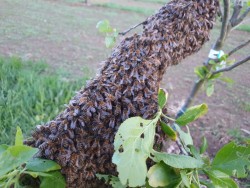
A swarm of honey bees
Can bees be classified as a nuisance? Is there any legislation regarding the siting of bees and beehives?
Under some circumstances, as a last resort, yes - although there is no specific legislation relating directly to the siting of bees.
If you have a problem regarding the siting of bees, the first advice is for both parties to talk to each other and see if an amicable outcome can be agreed. If the bees are acting as a nuisance, reasonable actions that could be taken by the beekeeper include moving the bees well away from the boundary or preferably reducing the numbers by moving some to an out apiary (a site well away from dwellings). It is possible for experienced beekeepers to safely manage bees in a garden area, although usual practice is to site them well away from neighbours and fence colonies in with a hedge or panelled fencing - this encourages bees to fly higher, above the heads of anyone nearby.
If after discussion the bees are still causing a problem, there are two potential courses of action:
- You could approach the British Beekeepers Association (BBKA). The BBKA are there to encourage responsible beekeeping and have produced helpful guidance regarding the siting of bees: Bees, Neighbours and Siting an Apiary. If the beekeeper is a member, the BBKA may be able to act as a mediator.
- Some local Environmental Health offices have been known to successfully invoke the Environmental Protection Act 1990 Section 79f 'Statutory Nuisances'. This is intended as an absolute last resort.
The NBU would not normally become directly involved with disputes involving the siting of bees.
What should I do if I see a lethargic bee in my garden or home?
These bees are usually exhausted or starving and feeding them with a solution of pure white cane sugar dissolved in water often results in a cure. Please do not use honey and water as some honeys may contain pathogens harmful to honey bees.
What should I do if I find a nest of bees in my garden?
Many species of wild bees may nest in your garden. There are over 270 species of wild bee in the UK and some of them nest underground, while others might nest in hollows of trees or bird boxes. As wild bees are not protected, there is nothing to stop you from having them removed. However, we strongly encourage that they be left alone, as wild bees are suffering widespread declines. None of these species are aggressive, and many are in decline, so they should be left alone.
Please read our fact sheet on wild bees in the UK to learn more about wild bees.
Honey bee diseases and disorders
Notifiable pest and diseases are European foulbrood (EFB), American foulbrood (AFB), small hive beetle, and the Tropilaelaps mite. If you find a notifiable pest or disease, you are legally required to report this to the National Bee Unit. Please go to our Contact Us page to find details of your local bee inspector. You can also contact the office team by calling 0300 303 0094 or emailing [email protected].
If you find a notifiable pest or disease and are in Scotland, please contact [email protected].
What is European foulbrood (EFB) and what are the symptoms?
European foulbrood is a bacterial infection of honey bee brood; you can learn more about the biology, symptoms and management of European foulbrood are described in detail in the advisory leaflet Foulbrood Disease of Honey bees.
EFB mainly affects unsealed brood. In infected colonies, the brood pattern will often appear patchy, larvae infected with EFB look melted or twisted. Dead larvae then turn yellow, then brown and eventually dry up to form a loosely attached brown scale. To learn how to identify of the signs of EFB, visit our How to spot European foulbrood page.

European foulbrood in various stages, compared to a healthy larva (top left)
What are the symptoms of American foulbrood (AFB)?
The biology, symptoms and management of American foulbrood are described in detail in the advisory leaflet "Foulbrood Disease of Honey bees". AFB generally only affects sealed brood; wax cappings become sunken and perforated and some cappings may be moist or greasy looking and slightly darker in colour than other cells. At the sunken capping stage, dead larval remains are light to dark brown in colour and have a slimy consistency. If a matchstick is inserted and slowly withdrawn, the remains can be drawn out in a brown, mucus-like thread or 'rope' 10 to 30 mm long. To learn more about identifying the signs of AFB, visit our How to spot American foulbrood page.
I think I have foulbrood disease in my colonies, what do I do?
If you have a smart phone, try to capture a photograph of the suspicious cells to show the bee inspector. Then close the hive, reduce the size of the entrance and take any other steps necessary to prevent the hive being robbed by other colonies. Disinfect gloves and other beekeeping equipment with a strong solution of washing soda before examining other colonies.
If you suspect European foulbrood (EFB) or American foulbrood (AFB), you must contact the National Bee Unit. If you are in Scotland, contact [email protected].
I have a question about other diseases or brood disorders (chalkbrood, chilled brood, etc).
We have two comprehensive advisory leaflets that describe in detail the most common adult and brood diseases of honey bees found in the UK. The advisory leaflet ‘Common pests, diseases and disorders of the adult honey bee’ covers adult diseases and ‘Foulbrood disease of honey bees’ contains information about other common brood diseases.
Pests of honey bees
What is the yellow-legged hornet?
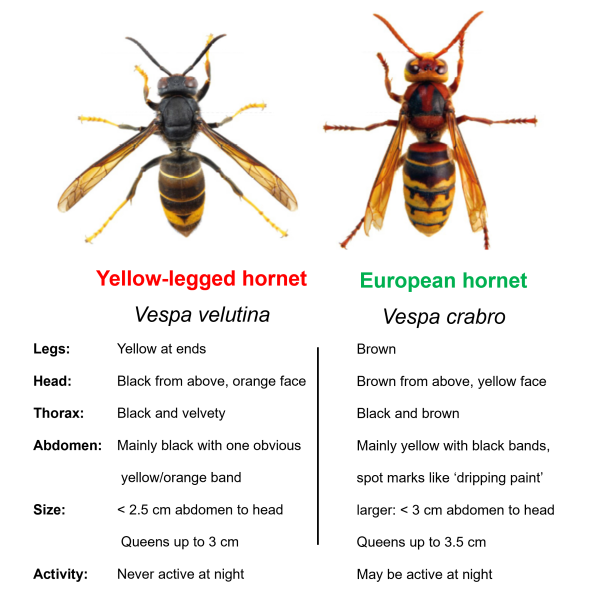
The yellow legged hornet (Vespa velutina nigrithorax), formerly known as Asian hornet, is a non-native hornet that is native to South-east Asia; China, India and Korea. It is slightly smaller than the native European hornet. Please note that it should not be confused with the giant hornet of Japan. You can read more about the yellow-legged hornet, and how to distinguish it from the native European species, Vespa crabro, and other common insect species on this identification sheet.
If you think that you have seen a yellow-legged hornet or a yellow-legged hornet nest, you can report your sighting by:
• Using the Asian Hornet Watch app for iPhone or app for android
• Filling in the Online recording form
• Emailing [email protected]
The yellow-legged hornet consumes honey bees and, at high densities, are capable of killing a colony of bees. It also predates a range of native species of insects such as wasps, flies and spiders. Invertebrate populations in the UK are experiencing declines and having an additional predator will increase pressure on them.
How do I tell a yellow-legged hornet from a native hornet or wasp?
The yellow-legged hornet is slightly smaller than the native hornet but bigger than wasps. Worker hornets are up to 2.5 cm (1 inch) long and queens up to 3 cm (approx. 1.2 inches) long. It is less orange overall than our hornet and has a distinctive yellow band on its otherwise black abdomen. This document provides more detail on how to identify a yellow-legged hornet. This 2021 BeeCraft article gives a helpful guide to differentiating between the invasive yellow legged hornet and native insects which are commonly mistaken for it: Asian hornet identity parade.
How do I know if I have Varroa?
Female Varroa mites are easily recognised by their flat, reddish-brown, oval-shaped bodies. They are 1.6 x 1.1 mm in size. Immature female mites and male Varroa mites are smaller and pale in colour and are only found in brood cells. Varroa mites are very small, if you wear glasses for reading you will probably need to wear them to see Varroa. A hand lens can be helpful too.
Varroa management is an essential part of beekeeping, all beekeepers need to make sure that they can recognise Varroa mites in their hives and have at least one method for estimating the level of infestation. Our fact sheet on estimating Varroa populations provides an overview of some of the ways to do this.
Mite populations in colonies need to be managed throughout the year. There are a variety of ways to do this. Visit our pages on Varroa for detailed guidance and images. You can also download a free copy of our Managing Varroa leaflet, which details all the treatment options available. Your local bee inspector will also be able to give you advice and guidance.
Honey bee research
Am I allowed to use honey bee diseases in scientific research?
If you are a researcher or scientist and would like to work with honey bee diseases, please be aware that the causative agents of European foulbrood and American foulbrood, Melissococcus plutonius and Paenibacillus larvae, cannot be handled without a licence. For information on what is required to obtain a licence, please contact: [email protected].
If you would like to work with any other diseases, a licence is not required. However, the NBU cannot provide samples of the causative agents of disease. To enquire about obtaining samples, please contact [email protected].
Please note that some causative agents of honey bee diseases are not easily cultivated or amenable to long-term storage. We recommend that you consult the COLOSS BeeBook Volume II to learn more about acquiring and processing field samples.
Funding opportunities
If you are seeking financial support for research, grants can be searched for through UK Research and Innovation (UKRI). Other organisations that provide funding include the British Beekeepers Association (BBKA), the Bee Diseases Insurance (BDI) Research Fund, and the CB Dennis Trust.
Can I access NBU data on honey bee diseases?
The NBU have access to data and statistics on honey bee diseases in England and Wales. To access data, individuals can submit an FOI request to [email protected].
Learn more about how to make a freedom of information request here: how to make a FOI request.
Please keep in mind that while personal data is collected to fulfil statutory requirements in relation to honey bee biosecurity, pests and disease control and management under UK legislation, we will not allow any unwarranted breach of confidentiality and we will not act in contravention of our obligations under UK data protection legislation. For more information on how we manage personal data, please view the NBU privacy notice here.