
Viruses can infect different stages and castes of honey bees, including larvae, pupae, adult worker bees, drones, and queens. Some viruses may predominately affect adult bees, while others will manifest in the brood stages. Please read our advisory leaflet on brood diseases for more information on those that affect brood.
Chronic bee paralysis virus (CBPV)
CBPV disease was rare for most of the past century, but in recent years reports have become more common and widespread, especially in the UK and USA. CBPV can affect the strongest colonies and cause dramatic symptoms within days of onset. Once signs of infection are evident, the colony has a 50:50 chance of survival.
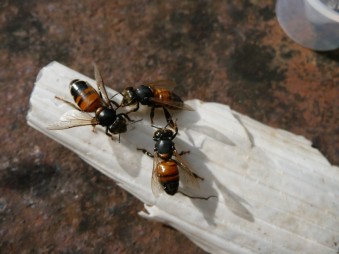 Adult bees showing hair loss as the result of a viral infection
Recognising signs of CBPV
The presence of trembling bees and black, shiny looking bees is a characteristic sign of CBPV. More subtle signs include bees with dislocated ‘K-wings’ and/or bloated, distended abdomens. The most heavily infected bees will be unable to fly, they will be obvious on the top bars of frames and will not disperse when smoked. Affected bees are subjected to nibbling attacks by their nestmates rendering them hairless. Some will be forcibly expelled from the entrance of the hive. As the disease progresses, dead bees and bees that are unable to fly accumulate in the floor of the hive and outside the entrance. A substantial pile of dead bees may accumulate in the hive when the disease is severe. The photograph above is a typical example of a CBPV infected bee.
A video showing symptoms of CBPV can be seen below:
Transmission
CBPV is transmitted via the faecal-oral route, via trophallaxis and by direct bee-to-bee (topical) contact. The virus is secreted onto the bee’s cuticle (skin) and can infect neighbouring bees on contact.
Bees can be infected by injection of the virus and although CBPV has been found in Varroa, there is no evidence to suggest that the mite acts as a vector.
Prevention and treatment
Avoiding overuse of pollen traps is recommended where CBPV has previously been present. It has been found that in apiaries previously affected by CBPV, colonies with pollen traps fitted had signs of the CBPV disease, while colonies without pollen traps did not.
Provide bees with plenty of space. When boxes become overcrowded, conditions are ideal for CBPV to proliferate, especially during bad weather, when bees stay in the hive. This promotes infection because the bees will have a lot of direct contact with one another.
Sick or dead adult bees and faeces inside the hive, are the main source of infectious material for the colony. If you wish to try and save the colony, remove as much of this infectious material as possible. Increasing the size of the hive entrance may help the colony to remove the dead bees and reduce the spread of virus inside the hive. Removal of floors is not recommended, because it can lead to robbing of the weakened colony, particularly later in the season when predation by wasps is at high levels.
Ensure the colony has ample access to pollen, because pollen stress is known to increase signs of CBPV and young bees raised during times of pollen dearth are more susceptible to the virus. Queens can also catch the virus and die, so check for a laying queen and take action if the queen is missing. There is no evidence that changing the queen will help manage the disease.
For more information about this virus, read our CBPV fact sheet.
Deformed wing virus (DWV)
The most prevalent virus in the UK, deformed wing virus (DWV), infects the majority of apiaries on mainland GB. In the UK, parasitic mite syndrome was one of the three most common diseases found (chalkbrood and sacbrood being the other two) in a study using NBU inspection data. DWV has become a serious cause of disease in honey bees following the invasion of the parasitic mite, Varroa destructor. Together high levels of Varroa and DWV can result in the colony-level condition called ‘parasitic mite syndrome’.
Recognising signs of DWV
Signs of DWV include dead pupae that fail to emerge and emerging bees with deformed wings and bloated, discoloured abdomens. Bees that emerge with deformed wings usually die in two to three days. Even healthy-looking bees can suffer from high levels of DWV and have impaired learning and memory thus reducing their ability to forage.
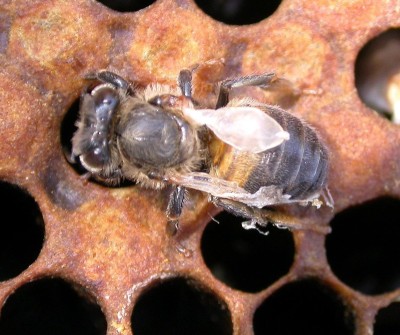 A young adult bee with Deformed Wing Virus showing typically shrivelled and deformed wings
Transmission
DWV is transmitted orally between workers via trophallaxis (when bees feed each other), sexually between drones and queens and vertically by queens to their offspring. When transmitted in these ways, the virus is usually at low levels and causes no overt signs of disease. However, the introduction of Varroa provided a new method of disease transmission by vectoring it between developing pupae. This vectoring assists the virus to reach much higher levels in the colony.
Treatment
As a high level of DWV infection in honey bees is linked to presence of Varroa mites, control of the mites helps control DWV infection. It has been demonstrated that mite control reduces the detectable DWV in the colony and improves colony overwintering survival. There are many products and husbandry techniques to control mite populations. No product offers 100% mite eradication and re-infestation will occur from neighbouring apiaries, so a long-term treatment regimen is necessary. If there are signs of mite damage accompanying DWV, a highly effective and fast acting Varroa treatment is urgently needed. The appropriate Varroa treatment will depend upon a number of factors including the time of year, the size of the colony, the brood status of the colony and whether honey supers are present. For more information on managing Varroa mites, please refer to our advisory leaflet ‘Managing Varroa’.
Other adult bee viruses
There are over twenty known honey bee infecting viruses, however, not all of them are found in the UK. In addition to those mentioned so far, some that have been found are: slow bee paralysis virus (SBPV), acute bee paralysis virus (ABPV), Israeli acute paralysis virus (IAPV) and Kashmir bee virus (KBV) but these are uncommon.
For more information on adult bee viruses, and other diseases of adult bees, please read our ‘common pests, diseases, and disorders of adult honey bees’ booklet.