
Nosema are parasites classified as ‘microsporidia’ that are related to fungi. They live inside the cells of other organisms and they need host cells to grow and divide but they can exist outside host cells in the form of spores. In this spore form they can move between hosts and spread. There are two main species of Nosema that infect honey bees: Nosema apis, which is native to Europe, and Nosema ceranae, thought to originate from East Asia.
Transmission
Nosema is transmitted via the faecal-oral route, through contaminated food, water, and surfaces. Nosema are gut parasites and the spores enter the bee gut, penetrate the gut cells and germinate. There, they multiply and cause disease in the host by damaging the gut cells and stealing nutrients needed by the bee. Eventually millions of spores are produced that infect more cells or pass into the faeces where they can contaminate the colony and be ingested by other bees.
Recognising signs of Nosema
Nosema apis
N. apis is difficult to recognise in honey bees because there are no definitive signs and the colony can appear completely fine despite infection. However, N. apis may cause dysentery, an increase in winter mortality, slow spring build up and reduced honey yield.
Nosema ceranae
N. ceranae is thought to be a more virulent parasite than N. apis based on laboratory experiments. N. ceranae manifests with dead bees outside the hive, bees crawling on grass outside the hive, and abnormally small adult bees. Infected colonies may experience spring dwindling of adult bee populations, decreased honey production and decreased brood production. In severe cases, it can kill colonies.
The only way to identify and diagnose Nosema, is through microscopy. To learn more, read our advisory booklet on common diseases, disorders and pests of the adult honey bee.
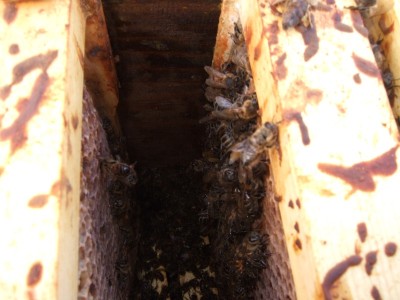
Dysentery is commonly seen in colonies suffering from Nosema apis
Treatment
Disease caused by Nosema apis infection is made worse by disturbing colonies, probably because of increased defecation inside the colony, so if infection is found, the colonies should be left alone for a few weeks, except to check they have enough food. Infection with N. apis should reduce markedly over the flying season as bees defecate outside the hive.
Infection may worsen if the colony is queenless so ensure the queen is present before leaving the colony to recuperate. If an old queen is present, it may help to replace her with a younger queen; this has been shown to reduce the proportion of infected workers.
Nosema is a gut parasite, so plentiful feed is essential to help the bees recover. Pollen is especially important, as insufficient pollen can worsen infection, especially for N. ceranae.
If all else fails and the infection is heavy, attempts can be made to control it by moving bees onto clean frames.
Spores can remain viable for a year or more, so combs contaminated with faeces from infected bees can re-infect a colony. Wax frames can either be rendered down and the wooden frames disinfected; or intact frames treated with acetic acid to kill the Nosema spores.
Acetic acid treatment of frames can disinfect frames of Nosema, chalkbrood, and amoebic disease, without the need to render down valuable wax.
Further Information
- Nosemosis of the Honey bee, OIE Terrestrial Manual 2008 (pdf)
- Bee Craft article: Nosema ceranae, Jan 2008 (pdf)