
Acarapis woodi is an endoparasite. It infests and damages the breathing tubes (tracheae) of bees. It is the causative agent of ‘acarine’ disease. Honey bees breathe through ten pairs of tiny holes called spiracles. These run along the thorax and abdomen. The holes lead into tubes called the tracheae, which run throughout the entire body of the bee so the oxygen is delivered directly to all the tissues. When A. woodi enters the tracheae of the bee, the mites block the tubes, which reduces the movement of oxygen to the flight muscles and the brain. Severe infestation shortens the lifespan of the bee.
Recognising signs of acarine
Tracheal mites can infest all castes; queen, workers and especially drones. Adult bees that are infested with tracheal mites cluster in front of the hive, appearing confused and disorientated, unable to return to the colony. Large numbers of bees may be seen crawling up stems of grass in front of the hive. Such behaviours are not unique to acarine. They may be associated with other pests and diseases, such as Nosema. Bees that are severely infested with mites can behave in a normal way despite their tracheae being damaged. Bee dissection and detection of mites in the tracheae under a low power microscope is the only reliable method of diagnosis.
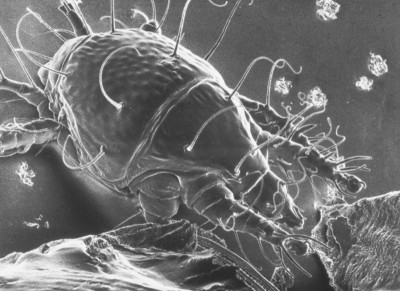
Electron micrograph of an A. woodi mite that causes acarine disease
Transmission
Mated adult female mites must leave their honey bee host to infest a fresh adult bee. This is the only time that mites are found externally on the bees. Tracheal mites cannot survive for more than a few hours outside their host, so this transfer takes place as quickly as possible within a colony. The female mite exits the bee trachea through the spiracle and uses its hind legs to anchor itself to one of the bee’s body hairs. It reaches out with the forelegs to grasp the hair of another passing bee and transfers to its new host. Only young bees in the first four days of adult life are susceptible, because the hairs in the trachea are not fully hardened thus allowing mites to enter. The spread of the mite requires the presence of young bees in the colony and their close contact with older, infested bees.
Dispersal of tracheal mites between colonies occurs by transfer of bees from infested to uninfested colonies via robbing and drifting.
Treatment
There are currently no approved treatments for acarine. The best method of control available to the beekeeper is to re-queen colonies that are susceptible to the disease.
Further Information
- More information about the tracheal mite can be found in our advisory leaflet: Common Pests, Diseases and Disorders of the Adult Honey Bee;
- Further information is available from the OIE Chapter on Acarapisosis.