
In the UK there are two species of wax moth: the lesser wax moth (Achroia grisella) and the greater wax moth (Galleria mellonella). The greater wax moth is considered a more destructive and common pest, while lesser wax moth is less prevalent and less destructive.
While adult wax moths cause no direct damage, the larvae tunnel under the brood cappings, feeding on honey, wax and pollen, damaging comb in the process. After the larvae finish feeding, they pupate in their cocoons. Greater wax moth larvae chew away at wood to create an area to attach their cocoons, making holes that can damage wooden and polystyrene beekeeping equipment and frames.
Transmission
Male and female moths mate in trees near apiaries but only female moths enter the hives in order to lay their eggs. They gain entry at night and lay their eggs in clusters in crevices in the hive; the eggs hatch into larvae which move onto the brood combs to feed. Infestations can be spread by movement of infested colonies and equipment.
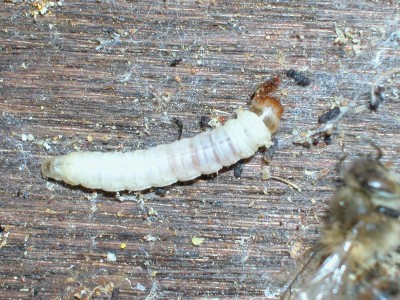
Wax moth larvae have pale, soft bodies, and brown heads
Damage to colonies
Wax moths are not damaging to bees in cold climates such as the UK but can be a real pest of stored comb and they can cause significant damage to stored beekeeping equipment. Wax moths do not parasitise the bees, but the presence of wax moth is linked to a brood condition called ‘bald brood’. Bald brood is a common disorder which results in small patches of brood cells becoming partially or completely uncapped. Bald brood may occur in a line above the burrowing wax moth larva. For more information on brood disorders, please read our advisory leaflet ‘Foulbrood disease of honey bees, and other common brood disorders’.
Treatment
Strong colonies can take care of minor wax moth infestations, so there is no need to treat the colony. However, if wax moth is a persistent pest in the colony, frames should be treated before storage or re-use.
One method to treat frames for wax moth is to freeze the frames for 48 hours before storage and to scrape off any wax moth cocoons on the boxes. This will kill all life stages of wax moth. Frames should be placed in tightly closed bags with zip-ties for freezing. After removal from the freezer, store them in the unopened bag until they are needed. Wax moths will be attracted to brood boxes or supers containing wax frames, so if frames cannot be stored somewhere wax-moth proof, or very cold, then keeping them bagged is the preferred solution.
Alternatively, acetic acid fumigation can be used on frames before going into storage to eliminate infestation.
For more information, please read our fact sheet about wax moth.